
Indonesia’s Aviation Roadmap to the Golden Vision 2045
Aviation is the lifeblood driving Indonesia’s economy every single day. For an archipelagic nation, airports determine whether business, logistics, and tourism are ready to soar onto the global stage or remain grounded.
At least four primary airports consistently serve as the backbone of national and international air traffic: Soekarno-Hatta International Airport in Tangerang (Banten), I Gusti Ngurah Rai International Airport in Denpasar (Bali), Juanda International Airport in Sidoarjo (East Java), and Kualanamu International Airport in Deli Serdang (North Sumatra). The dominance of these four anchor airports serves as the starting foundation for the government in drafting a more structured and ambitious national aviation blueprint—or roadmap—ahead of the grand Golden Indonesia 2045 vision.

Aviation Status Realignment: International vs. Big Domestic
Despite boasting numerous airports with grand infrastructure across various provinces, the government recently shifted its long-standing paradigm on airport prestige by slashing the number of international airports in Indonesia from 34 down to just 17 [1]. Looking closely through the lens of macroeconomic strategy and long-term aviation governance, this downsizing is a bitter pill to swallow—yet a deeply rational and necessary step.
This reduction carries a primary mission: tackling two long-standing issues in national aviation—route inefficiency and capital flight (foreign exchange leakage). For years, an excessive number of international airports created loopholes for foreign airlines to establish direct flights into second-tier Indonesian cities, bypassing domestic carriers. Consequently, local residents vacationing abroad could fly directly from their home cities on foreign airlines, leading to an unchecked drain of national revenue overseas.
Under the new policy, the dozen-plus airports stripped of their international status are being repositioned and optimized to function as “big domestic” hubs. The strategy aggressively strengthens the country’s internal hub-and-spoke network.
These big domestic airports are now tasked with gathering passengers from more remote regions or smaller cities (spoke airports) and routing them to major international hubs if they plan to travel abroad. This protective measure is directly designed to safeguard the local aviation ecosystem, boost domestic airlines’ passenger load factors, and breathe fresh economic life into transit airports across the archipelago.
Specialized Airports: Serving State Guests to Remote Industrial Hubs
Not all runways are meant for commercial civil aviation or open to the general public. Indonesia maintains a distinct operational category of “specialized airports” designated for very specific purposes—supporting strategic state interests and ensuring smooth operations for vital industries.
One of the most prominent examples of specialized airport development today is the VVIP Airport project in the Nusantara Capital City (IKN), East Kalimantan, officially named Nusantara International Airport. Designed exclusively to accommodate the movement of state guests, the president, and high-ranking government officials, this facility remains closed to regular commercial routes. To ensure the runway can handle presidential wide-body aircraft such as the Boeing 777-300ER, Nusantara Airport is built with a runway length of 3,000 meters and a width of 45 meters [2].
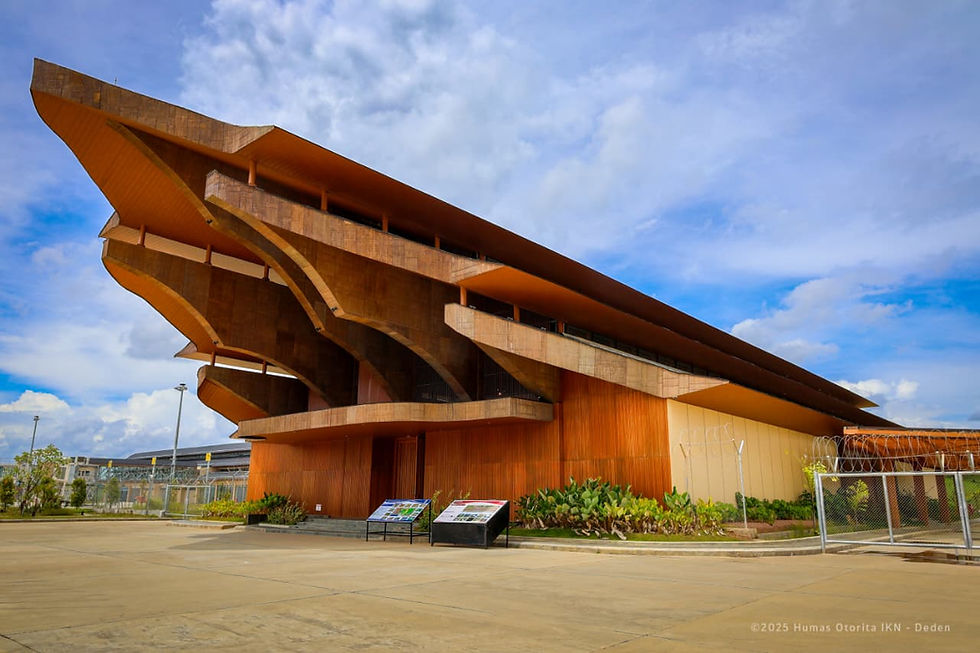
Specialized airports are also widespread across eastern Indonesia, backing mining sectors and downstream industrial processing located in extreme terrain. For instance, private airfields within the Indonesia Morowali Industrial Park (IMIP) in Central Sulawesi function as logistics and transit facilities for nickel mining technical experts.
There is also a long history behind Mozes Kilangin Airport in Timika, Papua. In its early days, this infrastructure was purely a specialized airport built and managed entirely by PT Freeport Indonesia to support their giant copper and gold mining operations. Over time, as community needs grew, the airport was gradually opened to serve pioneer commercial civil flights.
Aviation Vision 2045: Building an Integrated Ecosystem and Super Hub
Under the Golden Indonesia 2045 Aviation Masterplan, the government has set a clear target: the national aviation landscape must no longer operate sporadically or in regional silos, but must instead be bound tightly within a comprehensively integrated ecosystem.
The nation’s strategic geographic location should no longer merely serve as an easy market for foreign ticket sales, but rather as Southeast Asia’s aviation Super Hub—seamlessly linked across the wider Asia-Pacific. The core backbone international airports retained will be continuously upgraded in terms of both capacity and technology adoption to compete head-to-head with regional heavyweights.
Intermodal transportation integration will serve as a key metric of success. Big domestic airports are designed to eventually connect seamlessly with land and sea transport networks, creating an efficient supply chain flow.
However, reducing the number of international airports has sparked mixed emotions—ranging from fears over losing direct flight access to optimism about strengthening domestic carriers. The answer hinges on one ultimate challenge: Indonesia’s capacity to compete on the regional stage and fulfill its dream of becoming Southeast Asia’s premier aviation Super Hub by 2045.
The Mega-Overhaul of 30+ Indonesian Airports
To answer the challenge of surging passenger traffic while supporting future logistics and tourism growth, the Ministry of Transportation has launched a massive program to rehabilitate, expand, and upgrade the capacity of over 30 airports nationwide [3]. This multi-trillion-rupiah undertaking doubles as a strategic catalyst, triggering a ripple effect across various industrial sectors.
The core rationale behind these airport expansions centers on two critical factors: terminal capacity and runway specifications.
On the terminal side, many airports in tier-2 cities—originally designed to handle only hundreds of thousands of passengers annually—are now catering to millions. Indonesia’s aviation sector is showing a robust recovery; PT Angkasa Pura Indonesia (InJourney Airports) recorded over 119 million passenger movements throughout 2023, underscoring the sky-high demand for domestic air mobility [4].
Meanwhile, runway extensions and asphalt resurfacing are vital to allow regional airports to accommodate wide-body jets like the Airbus A330 or Boeing 777. If a runway is too short or lacks pavement thickness, airlines are forced to operate only narrow-body or turboprop (ATR) aircraft. Upgrading these airside facilities enables carriers to transport significantly more passengers and cargo in a single flight, ultimately driving down inter-island logistics costs.
Listed Construction Companies as the Backbone of Development
Behind the roar of heavy machinery and construction dust lies a far more intriguing question for investors: who stands to capture this massive flow of capital?
Whenever the government or airport operators announce multi-trillion-rupiah expansion projects, eyes on the Indonesia Stock Exchange (IDX) automatically turn to construction sector stocks—specifically state-owned enterprise (SOE) contractors. They are the primary beneficiaries of these infrastructure megaprojects and the boots on the ground physically building a pillar of Golden Indonesia 2045.
Airport construction demands high-level technical specifications, strict international safety standards, and extensive portfolio experience. Tenders for major airport developments are almost always clinched by construction giants such as PT PP (Persero) Tbk. (PTPP) and PT Adhi Karya (Persero) Tbk. (ADHI).
For example, PTPP boasts a stellar track record in landing strategic projects, including Yogyakarta International Airport (YIA) in Kulon Progo, Komodo Airport in Labuan Bajo, and Halim Perdanakusuma Airport in Jakarta. Securing these jumbo aviation contracts guarantees long-term revenue visibility for years to come.

The Ripple Effect on Supporting Ecosystems: A Reflection of 2045 Connectivity
The windfalls don’t stop with main contractors. Issuers providing precast concrete and ready-mix solutions are riding the surge in demand driven by apron expansions, taxiway construction, and runway extensions that require ultra-durable materials. SOE construction subsidiaries like PT Wijaya Karya Beton Tbk. (WTON) regularly serve as key material suppliers for these projects.
Furthermore, a sprawling, modern airport is rendered ineffective without robust ground access. Airport expansions are consistently paired with new toll road developments or arterial road widenings. This creates lucrative opportunities for toll road operators like PT Jasa Marga (Persero) Tbk. (JSMR). Toll roads directly connected to airports consistently log high and stable daily traffic volumes. Such intermodal integration offers a microcosm of the connectivity envisioned for Golden Indonesia 2045: an efficient logistics ecosystem supporting seamless mobility.
The Bottom Line
The multi-airport upgrade program across 30+ Indonesian airports is both a massive business ecosystem and the logistical bedrock of Golden Indonesia 2045. From architectural designers and precast concrete manufacturers to toll road operators smoothing out transit, every link in this infrastructure supply chain is tightly interconnected. Ultimately, this delivers a tangible catalyst for capital market earnings growth while pushing Indonesia forward on its long march toward a century of independence.
At its core, transforming basic asphalt airfields into large-scale economic integrators is the heart of the 2045 aviation roadmap. Through international status realignments, dedicated domestic feeder networks, and consolidated logistics connectivity, Indonesia is laying a firm foundation for a sovereign, self-reliant aviation industry—fully prepared to lift the nation’s economy onto the world stage.
References
[1] Kementerian Perhubungan Republik Indonesia, mengenai Kepmenhub Nomor 31 Tahun 2024. Tautan: Kemenhub - Aturan Baru Tentang Status Bandara Internasional
[2] Sekretariat Kabinet Republik Indonesia, spesifikasi pembangunan runway Bandara IKN. Tautan: Setkab RI - Pembangunan Bandara IKN Ditargetkan Rampung Desember 2024
[3] Kementerian Perhubungan Republik Indonesia, Laporan Kinerja mengenai target pengembangan/rehabilitasi bandara dalam RPJMN 2020-2024. Tautan: Kemenhub - Capaian Kinerja Infrastruktur Transportasi
[4] PT Angkasa Pura Indonesia (InJourney Airports), Laporan pergerakan penumpang tahun 2023. Tautan: Antara News - InJourney Airports Layani 119 Juta Penumpang Selama 2023
Disclaimer: This content is created for educational purposes or service promotion, and does not constitute a recommendation to buy or sell any specific Securities. Any risks arising from investment decisions made based on the information in this publication are the sole responsibility of the respective audience. PT KAF Sekuritas Indonesia is licensed and supervised by the Financial Services Authority (Otoritas Jasa Keuangan / OJK).


Comments